Gangnam Astigmatism Surgery in Seoul: How to Choose the Right Procedure for Glasses-Free Vision

Astigmatism Surgery Options in Gangnam, Seoul
In Gangnam, Seoul, you can find several options for astigmatism surgery aimed at reducing or eliminating dependence on glasses. Astigmatism can be corrected surgically in two main ways: reshaping the cornea with laser vision correction, or implanting special lenses inside the eye.
Many patients who visit a specialized ophthalmology clinic near Gangnam Station in Seoul come with one main goal: to correct astigmatism and reduce their dependence on glasses or contact lenses. Some are local residents, while others are international patients planning surgery during a short stay in Korea.
Once at the clinic, patients undergo a detailed eye examination to measure corneal shape, thickness, tear film, lens status, and overall eye health. Based on these results, the medical team first decides whether a corneal laser procedure or a lens-based procedure is more appropriate.
Laser options include SMILE-type laser, SILK, and LASIK/LASEK-type procedures, while lens-based options include ICL, GLAZE, PhakiFlex KPL, and toric or multifocal intraocular lenses. For international patients, the process usually starts with an online consultation, followed by a comprehensive in-clinic assessment on arrival, surgery within a few days, and post-operative checks before returning home.
What is astigmatism and why does it blur vision
Astigmatism is a focusing error of the eye. Instead of being perfectly round like a basketball, the cornea or internal lens is shaped more like a rugby ball. Because of this uneven curvature, light entering the eye does not focus at a single sharp point on the retina.
People with astigmatism often notice blurred or distorted vision at all distances. Straight lines may look slightly tilted or stretched, and small text can appear shadowed or doubled. Astigmatism often occurs together with nearsightedness or farsightedness, which can make focusing even more difficult.
In mild cases, glasses or contact lenses with a cylindrical prescription can correct the distortion. In higher or irregular astigmatism, or when patients want more freedom from glasses and contact lenses, surgical correction can be considered.
When glasses are enough and when surgery is considered
For many people, glasses or soft toric contact lenses provide good quality vision. If you are comfortable with your current correction, have no issues with dry eye, and do not mind wearing glasses or contacts, surgery is not mandatory.
Surgery becomes a realistic option when:
You want to reduce dependence on glasses or contact lenses for daily life or sports.
You have difficulty wearing contact lenses because of dryness, allergies, or discomfort.
Your astigmatism is stable for at least one to two years.
You have realistic expectations and understand both benefits and risks.
On the other hand, surgery may not be recommended if your prescription is still changing quickly, if you have uncontrolled eye disease, or if your cornea is too thin or irregular for safe laser treatment. In these cases, lens-based options or continued use of glasses may be safer.
Overview of surgical options for astigmatism
laser options, while patients who are already noticing presbyopia or early cataract are more likely to discuss lens procedures that can address several issues at once.
Corneal laser procedures for astigmatism
Corneal laser vision correction reshapes the front surface of the eye so that light focuses more precisely on the retina. At a specialized ophthalmology clinic in Gangnam, several corneal laser options are available.

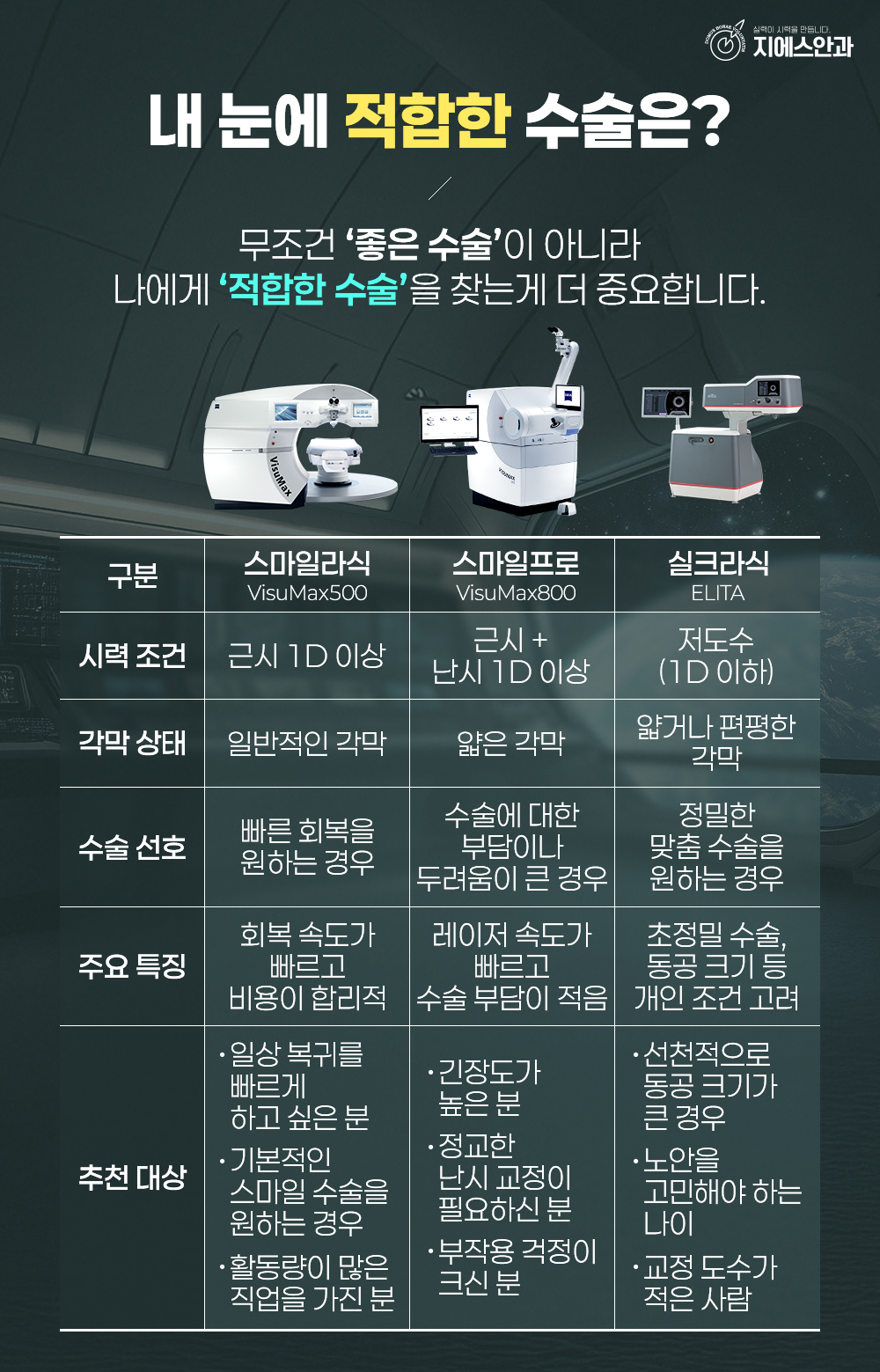
SMILE Pro and SMILE LASIK
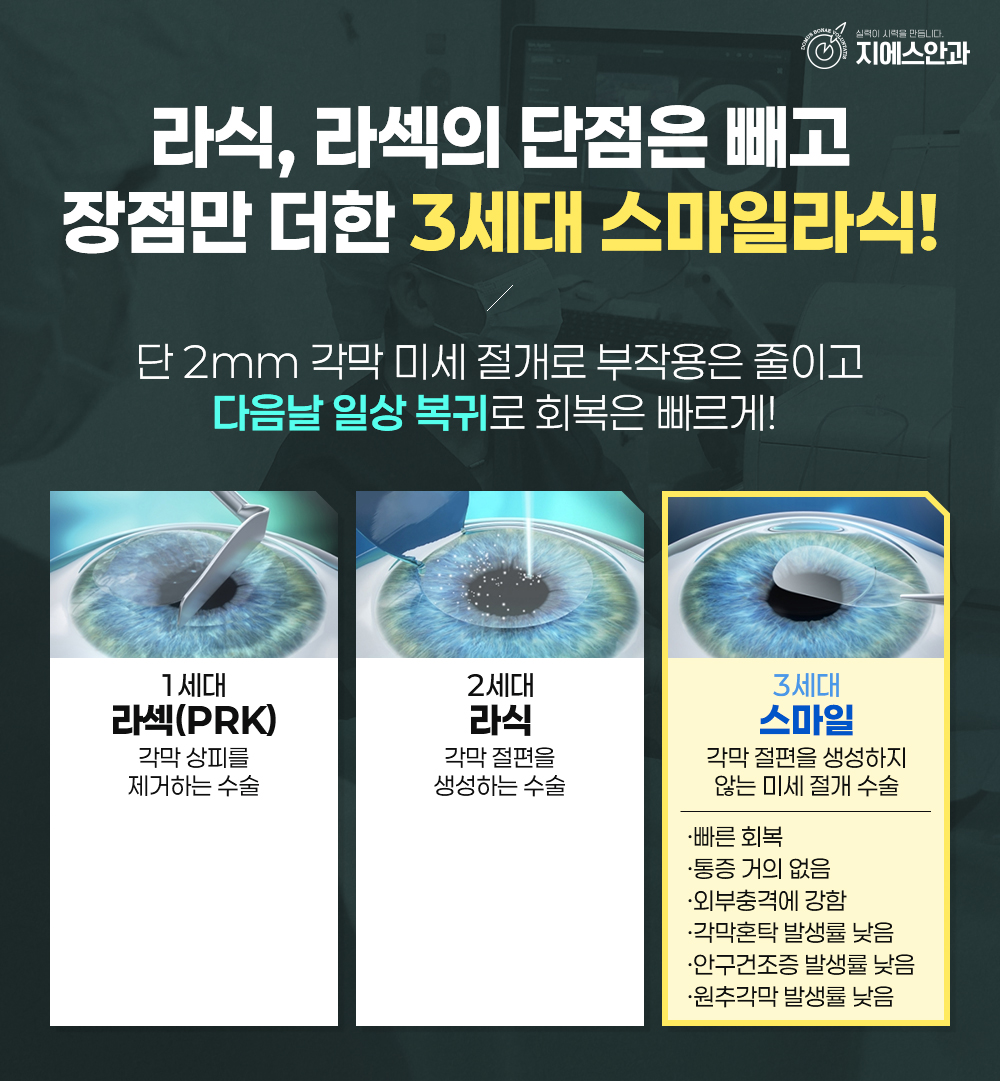
SMILE stands for Small Incision Lenticule Extraction. With SMILE, a femtosecond laser creates a tiny lens-shaped piece of tissue inside the cornea, which is then removed through a small incision. This changes the curvature of the cornea and corrects astigmatism and myopia.
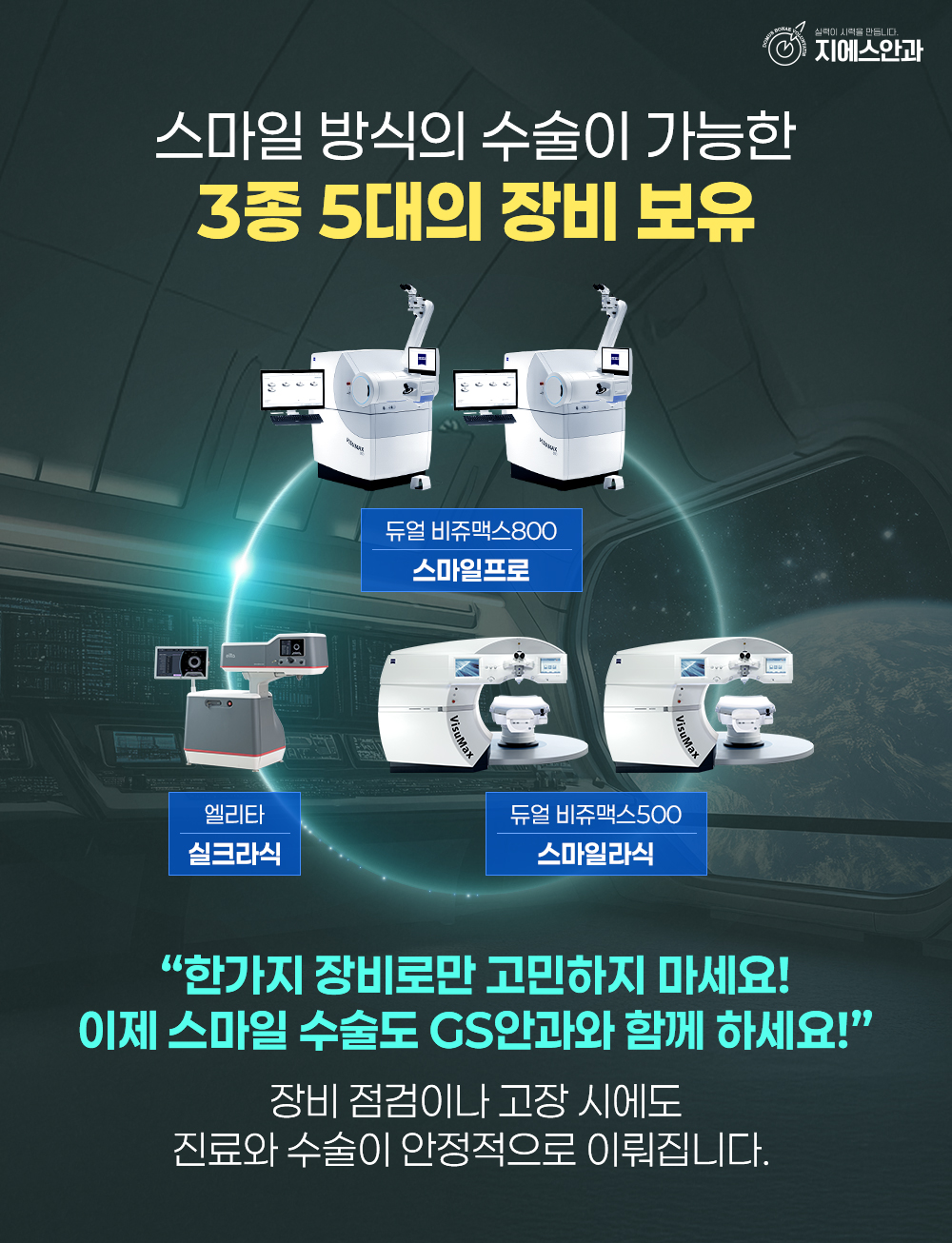
SMILE Pro uses the latest ZEISS VisuMax 800 platform. One of its advantages is a short laser time, around 9 seconds, which reduces the time you need to fixate during the procedure. SMILE LASIK at this clinic uses two VisuMax 500 units, allowing flexible scheduling and high case volume.
Compared with traditional LASIK, SMILE uses a smaller incision and does not require creating a large corneal flap. This can help preserve more corneal strength and may reduce the risk of dry eye symptoms in some patients.
SILK flapless laser
SILK is a newer, flapless corneal laser technique. Like SMILE, it aims to correct vision through a small opening rather than a wide flap. This can be an option for patients who prefer a minimally invasive approach, or whose corneal shape is better suited to this pattern of tissue removal.
The clinic is designated as a SILK training center, meaning other doctors visit to learn advanced laser techniques there. For patients, this suggests that the team has substantial hands-on experience with this platform and its treatment protocols.
Golden SMILE customized protocol
rneal patterns or higher astigmatism, where small changes in how the tissue is cut can influence both astigmatism correction and overall visual quality.
Golden SMILE is the name of a proprietary customized SMILE protocol used at this clinic. It is not a generic term, but a program that adjusts laser parameters based on each patient’s corneal shape, thickness, and visual needs. The goal is to fine-tune astigmatism correction and visual quality rather than using a one-size-fits-all setting.
2DAY LASEK and surface ablation
For some patients, especially those with thinner corneas or certain lifestyle needs, surface ablation procedures such as LASEK are preferred. 2DAY LASEK is a modern surface ablation approach that aims to reduce discomfort and shorten the initial recovery period compared with older techniques.
In surface ablation, the laser reshapes the surface of the cornea without creating a flap. This preserves more tissue and can be safer for borderline corneal thickness, but early recovery is usually slower than SMILE or LASIK-type procedures.
Corneal strengthening with cross-linking
In cases where the cornea is relatively thin or shows signs of biomechanical weakness, corneal cross-linking may be added. This procedure uses riboflavin drops and ultraviolet light to strengthen the collagen fibers in the cornea.
The purpose is not to correct vision by itself, but to stabilize the cornea and reduce the risk of progressive thinning after laser vision correction. Combining cross-linking with astigmatism surgery can be considered for selected patients after detailed evaluation.
Lens-based options for astigmatism
Lens-based surgery corrects astigmatism by placing a specially designed lens inside the eye, either in front of the natural lens or replacing it.
Phakic lens implantation (ICL, GLAZE, PhakiFlex KPL)
Phakic lenses are implanted in front of your natural lens without removing it. They are suitable for patients with high astigmatism, very strong myopia, or corneas that are too thin or irregular for safe laser reshaping.
At this Gangnam clinic, several phakic lens platforms are used, including ICL, GLAZE, and PhakiFlex KPL. The clinic has extensive experience with the GLAZE phakic lens platform. This experience is important when planning surgery for complex or high-degree astigmatism.
Phakic lenses can be an excellent option if you want reversible correction, because the lens can be exchanged or removed if needed in the future. They are usually considered for younger adults whose natural lens is still clear.
Toric and multifocal intraocular lenses for cataract and presbyopia
For patients in their 40s and above, especially those with cataract or age-related changes in the natural lens, lens replacement surgery may be more appropriate than corneal laser.
During cataract or refractive lens surgery, the cloudy or aging natural lens is removed and replaced with an artificial intraocular lens. Toric intraocular lenses are designed with built-in astigmatism correction. Multifocal or extended depth-of-focus lenses, such as PanOptix and other premium lenses, can improve both distance and near vision, reducing dependence on reading glasses.
This clinic has extensive experience with premium multifocal and toric intraocular lenses. For older patients with astigmatism, combining cataract or presbyopia surgery with toric and multifocal lenses can address several issues at once: blur from astigmatism, cloudy vision from cataract, and difficulty with near tasks.
Importance of detailed preoperative examination
Astigmatism surgery planning starts with a comprehensive eye examination. For international patients, this is usually performed on the first visit to the clinic in Seoul.
Before recommending any astigmatism surgery, the clinic first looks closely at the front of the eye. The shape and curvature of your cornea are mapped in detail, because this is where the team can roughly judge which procedures are even on the table. Corneal thickness and biomechanical stability are then checked to see how much tissue can be safely treated. After that, factors like pupil size and tear film quality are reviewed, since they can affect night vision and comfort. Finally, the retina and optic nerve are examined to rule out other eye diseases that could limit the final result, even if the front of the eye looks ideal for surgery.
y is safe or whether lens-based options are better.
Corneal thickness and biomechanics
Measuring corneal thickness and biomechanical properties helps the medical team estimate how much tissue can be safely removed and whether corneal strengthening procedures should be considered.
Pupil size and tear film evaluation
Pupil size in different lighting conditions affects night vision, glare, and halos after surgery. Tear film quality and dry eye status are also checked, because dry eye can affect both healing and visual clarity. This clinic has a dedicated dry eye clinic to manage these issues before and after surgery.
Retina and optic nerve check
In patients with high myopia or older age, the retina and optic nerve are examined carefully. Conditions such as lattice degeneration, macular changes, or glaucoma risk need to be identified and managed to protect long-term vision. The clinic also has a dedicated retina center for this purpose.
How this Gangnam clinic approaches astigmatism surgery
This ophthalmology clinic near Gangnam Station has been operating for many years in the same location. It is led by board-certified ophthalmologists with experience in university hospitals and subspecialty training, including retina care. The medical team focuses on refractive and cataract surgery as a major part of their daily practice.
The clinic is recognized as a clinical education center for a medical school and for an international ophthalmic company in the field of refractive and cataract education. It uses multiple SMILE-related laser platforms from ZEISS, including the latest VisuMax 800 for SMILE Pro, and also serves as an official SILK training center.
Because other doctors visit to learn these techniques and use the equipment on site, the team performs a wide variety of refractive and cataract cases, including high myopia and high astigmatism. This training and case mix help maintain familiarity with different platforms and approaches, which can give patients more options that fit their individual eyes.
Over the years, the clinic has accumulated extensive experience in vision correction and cataract surgery. It also performs a high volume of SMILE Pro, phakic lens, and premium multifocal lens procedures as part of its refractive and cataract services.
For patients, this translates into an individualized approach rather than a single standard operation. The medical team can choose among SMILE Pro, SMILE LASIK, SILK, 2DAY LASEK, other surface ablation techniques, phakic lenses such as ICL, GLAZE, and PhakiFlex KPL, and toric or multifocal intraocular lenses. The choice depends on your corneal shape, degree of astigmatism, age, lifestyle, and long-term goals.
Role of dry eye and retina care in visual quality
Astigmatism correction is not only about the cornea or lens. Dry eye, meibomian gland dysfunction, and retinal conditions can all influence how sharp your vision feels after surgery.
The dedicated dry eye clinic focuses on stabilizing the tear film before and after surgery. This may involve detailed tear testing, lid hygiene, medications, or in-office treatments. A stable tear film helps the corneal surface heal smoothly and supports clearer vision.
The retina center evaluates and monitors the back of the eye, especially in high myopia, older patients, or those with systemic conditions such as diabetes. Treating or monitoring retinal issues can be as important as correcting astigmatism when it comes to overall visual quality.
Safety, risks, and realistic expectations
Each type of surgery has its own risk profile and recovery pattern, and not every option is suitable for every eye. Discuss with your doctor which procedures fit your corneal shape, prescription, and lifestyle, and ask specifically about expected recovery time, night vision, and how astigmatism correction will be checked after surgery.
All surgical procedures carry some risk, and individual results can vary. Common temporary side effects after astigmatism surgery include dry eye symptoms, glare, halos around lights at night, and mild fluctuations in vision during the healing period.
Under-correction or over-correction can occur, especially in very high prescriptions or complex corneal shapes. In some cases, an enhancement procedure or adjustment may be considered after the eye has stabilized.
Recovery time varies by procedure and by person. With SMILE‑type, SILK, and most LASIK‑type surgeries, many patients feel their vision is usable within a short period, then notice dryness or small ups and downs in clarity over the next days to weeks as the eye settles.
Surface procedures such as LASEK usually have a different course: more discomfort in the first days and a slower climb in sharpness, which is one reason they are kept for specific corneal situations rather than as a first choice for everyone. Lens‑based procedures often bring a clear change in focus soon after surgery, but activity limits and follow‑up visits are spaced out according to the details of that particular lens surgery.
SMILE-type and SILK procedures
Many patients notice functional vision within one or two days, with gradual refinement over several weeks. Discomfort is usually mild.
LASIK-type procedures
Vision often improves quickly, sometimes within hours to a day, but dryness and night vision symptoms can take weeks to months to settle.
LASEK and surface ablation
Early recovery is slower, with more discomfort in the first few days and a more gradual return to clear vision over one to two weeks or longer.
Lens-based procedures
After phakic lens implantation or cataract lens surgery, vision often improves within days, but the brain needs time to adapt to new optics, especially with multifocal lenses.
Long-term stability is generally good when the procedure is correctly matched to the patient’s eye condition and when the cornea or lens is healthy. Regular follow-up is important to monitor healing, manage dry eye, and check retinal health.
Who may consider astigmatism surgery in Korea
ive lenses. The clinic will also look at overall health, eye condition, and lifestyle needs rather than relying on a simple checklist.
Are generally healthy and at least in your early 20s.
Have a stable glasses or contact lens prescription for at least one to two years.
Have astigmatism with or without myopia or hyperopia.
Want to reduce dependence on glasses or contacts for work, study, or sports.
Are willing to follow pre- and post-operative instructions and attend follow-up visits.
For younger adults with healthy corneas, SMILE, SILK, LASIK-type, or LASEK-type procedures are often considered. For those with high prescriptions, thin corneas, or irregular shapes, phakic lenses may be safer. For patients in their 40s or older with presbyopia or cataract, toric and multifocal lens surgery may be more appropriate.
Online consultation and pre-visit preparation for overseas patients
If you are considering astigmatism surgery in Gangnam from overseas, an online consultation is a practical first step. Before your video or email consultation, it helps to prepare the following:
Your latest glasses prescription and, if possible, contact lens prescription.
Any previous eye examination reports, especially corneal topography or OCT scans.
A brief medical history, including systemic diseases, medications, and allergies.
Information about previous eye surgery or trauma.
Your main goals, such as driving without glasses, sports, or reading without glasses.
During the online consultation, you can discuss whether you are more likely to be a candidate for laser or lens-based procedures, how long you should stay in Korea, and what kind of recovery you can expect.
Questions you may want to ask include:
- Which procedures are likely to suit my eyes based on my current prescription
- How many days should I plan to stay in Seoul for examination, surgery, and follow-up
- What are the main risks and possible side effects for my situation
- What kind of aftercare is available once I return to my home country
Expected Korea visit flow for astigmatism surgery
International patients often choose between a short stay of around three to four days and a slightly longer visit of about a week. In a shorter stay, the first day is usually devoted to a full examination and planning, with surgery following soon after once the results are reviewed. The remaining time is used for early checks to confirm healing is on track before flying home.
Those who prefer more margin for rest and follow‑up may stay closer to a week. In that case, the initial exam and surgery are still grouped early in the visit, but there is extra time built in for additional check‑ups and for the eyes to settle a bit more before international travel.
Although exact plans vary, a typical schedule for international patients might look like this:
Day 1: Arrival and comprehensive examination
You visit the clinic near Gangnam Station for a full eye examination, including corneal imaging, tear film evaluation, and retina check. The doctor reviews the results, explains suitable options, and confirms the final surgical plan.
Day 2 or 3: Surgery
Most laser or phakic lens procedures can be scheduled within one to two days after the examination, depending on your eye condition and the clinic’s schedule. The surgery itself usually takes less than 30 minutes per eye.
Day 3 to 5: Early follow-up
You return to the clinic for one or more early follow-up visits. The medical team checks healing, removes any temporary protective lenses if used, and adjusts eye drops.
Day 5 to 10: Additional checks and clearance for travel
Before you fly home, the doctor confirms that your eyes are healing as expected and provides written instructions for ongoing care. For lens-based procedures or more complex cases, a slightly longer stay may be recommended.
Aftercare and follow-up once you return home
After you leave Korea, you will usually continue using prescribed eye drops for several weeks, following a tapering schedule. You should avoid eye rubbing, swimming pools, and heavy eye makeup for a certain period, depending on the procedure.
It is helpful to schedule a follow-up with a local eye doctor in your home country within a few weeks to a few months after surgery. The Gangnam clinic can often provide a summary letter in English to share with your local doctor.
If you experience sudden pain, vision loss, or severe redness at any time, you should seek urgent eye care locally and contact the clinic in Seoul for advice.
Special considerations for older patients and those with cataract or presbyopia
For patients in their mid-40s and beyond, presbyopia (difficulty focusing at near) and early cataract changes become more common. In these cases, simply reshaping the cornea may not fully address visual needs.
Combining astigmatism correction with cataract or refractive lens surgery using toric and multifocal intraocular lenses can:
Improve distance vision by correcting astigmatism.
Reduce or remove blur from cataract.
Decrease dependence on reading glasses by using multifocal or extended depth-of-focus lenses.
The choice of lens type depends on your lifestyle, night driving needs, tolerance for halos, and any retinal or optic nerve conditions. A detailed discussion with the surgeon is essential to set realistic expectations.
Key points to remember about astigmatism surgery in Gangnam Seoul
When considering astigmatism surgery in Gangnam, the most common questions center on safety and recovery. In general, modern astigmatism procedures are designed to be done with numbing drops, so patients usually feel pressure or mild discomfort rather than sharp pain during surgery, with temporary scratchiness or dryness afterward.
Another frequent concern is how quickly daily life can resume. Many people return to light activities within days after laser or lens‑based procedures, while tasks that demand very sharp or prolonged vision are often phased back in more gradually according to the specific surgery and the surgeon’s guidance.
Am I eligible for astigmatism surgery if I have high astigmatism
Many patients with moderate to high astigmatism can be treated, but the method may differ. For very high astigmatism or thin corneas, lens-based options such as phakic lenses or toric intraocular lenses are often considered instead of, or in combination with, laser procedures. A full examination including corneal topography and thickness measurement is needed to determine eligibility and safety.
Is astigmatism surgery painful
Most modern astigmatism procedures are performed with numbing eye drops. You may feel pressure or mild discomfort during the laser or lens implantation, but not sharp pain. After surgery, some patients experience a foreign body sensation, tearing, or light sensitivity for a few days, especially with surface ablation procedures like LASEK. Pain is usually manageable with prescribed medications and improves as the eye heals.
How long does it take to recover and return to normal activities
Recovery time depends on the procedure. With SMILE-type, SILK, or LASIK-type surgery, many patients can resume light activities and office work within a few days, although vision may continue to refine over several weeks. With LASEK and other surface ablation methods, functional vision may take one to two weeks or more. After lens-based surgery, most daily activities can resume within a few days, but your doctor may advise avoiding heavy lifting or strenuous exercise for a short period.
Can astigmatism surgery be repeated or adjusted if my vision changes
In some cases, enhancement or adjustment procedures are possible if there is significant under-correction or over-correction after the eye has stabilized. The feasibility of repeat laser depends on remaining corneal thickness and stability. For lens-based surgery, lenses can sometimes be exchanged or rotated if necessary. Any decision about additional procedures requires careful examination and discussion of risks and benefits.
Soft call to action for online consultation
If you are considering astigmatism surgery in Seoul and want to understand which options may suit your eyes, an online consultation with the Gangnam ophthalmology clinic can be a practical first step. By sharing your current prescription, previous test results, and visual goals, you can receive a preliminary assessment and a suggested visit plan.
When you are ready, you can coordinate your travel schedule, examination, surgery, and follow-up so that your time in Korea is used efficiently and safely. After detailed testing, you and your surgeon can choose between laser procedures and lens-based options to match your vision needs and daily activities.






댓글
댓글 쓰기